
Pedagogical strategies based on the 4C/ID model and Kolb’s experiential learning cycle for practical-experimental learning
Keywords:
experiential learning; 4C/ID model; pedagogical strategies; higher technological education; learning transferAbstract
Introduction: The article highlights the need to renew educational practices in higher technical training through strategies that balance theory and practice, given that traditional methods are insufficient for developing complex professional competencies. For this purpose, it analyzes the joint application of the 4C/ID model and Kolb’s experiential learning cycle as a methodological alternative capable of responding to the current demands of technological education. The main objective is to determine the effectiveness of pedagogical strategies based on both approaches within technical subjects with a strong practical and experimental component, assessing their impact on the development and strengthening of competencies. Materials and Methods: A quantitative quasi-experimental design was employed, combining structured observation and interviews with teachers from four technical subjects. The intervention was structured through authentic tasks, guided practice, and concrete experiences accompanied by reflection and application. The results show improvements in conceptual understanding, practical performance, knowledge retention, and transfer to real world situations. Likewise, teachers highlighted the positive adaptation to diverse learning styles, although they noted logistical limitations and some difficulty in the reflection phases. In conclusion, the integration of the 4C/ID model and Kolb’s cycle enhances practical and experimental learning and constitutes a relevant strategy for contemporary technological education.
References
Cárdenas, A., & López, M. (2024). Implementación del modelo 4C/ID en la educación técnica de América Latina: Una revisión sistemática [Revisión sistemática no publicada]. Instituto Superior Tecnológico "Centro Tecnológico Naval".
Espinosa Lara, E. P. (2022). Diseño de estrategias pedagógicas digitales en la Formación Técnico Tecnológica (FTT), fundamentado en el modelo instruccional 4C/ID [Tesis de maestría, Pontificia Universidad Católica del Ecuador]. Repositorio Institucional PUCE. https://repositorio.puce.edu.ec/handle/20.500.12790/8474
Gómez, P., Vera, S., & Luna, R. (2023). La combinación del modelo 4C/ID con el aprendizaje experiencial de Kolb en electrónica aplicada. Revista de Innovación en Enseñanza Técnica, 12(3), 45-60.
Guzmán, R. (2022). La aplicación conjunta de modelos pedagógicos en programas de educación técnica [Monografía de especialización, Universidad Nacional de Educación]. Repositorio UNAE.
Hirata Kitahara, M. (2020). Aprendizaje complejo y nuevas estrategias didácticas para una enseñanza transdisciplinar del Diseño. En M. Hirata Kitahara (Ed.), Aprendizaje complejo y nuevas estrategias didácticas para una enseñanza transdisciplinar del diseño (pp. 45-53). Universidad Autónoma Metropolitana, Unidad Azcapotzalco. https://zaloamati.azc.uam.mx/handle/11191/8764
Kolb, D. A. (1984). Experiential learning: Experience as the source of learning and development. Prentice Hall.
Lion, C. (2005). Los simuladores. Su potencial para la enseñanza universitaria. Cuadernos de Investigación Educativa, 2(12), 53-66. https://www.redalyc.org/pdf/4436/443643893005.pdf
Morales, J., & Torres, L. (2021). La convergencia pedagógica: Aplicación conjunta del modelo 4C/ID y el ciclo de Kolb en educación superior técnica. Journal of Technical Education and Training, 13(1), 112-128. https://doi.org/10.30880/jtet.2021.13.01.010 (¡VERIFICA ESTE DOI!)
Olmos Saborido, F. (2024). Análisis de simuladores de navegación para uso personal y su aplicación como complemento a asignaturas del grado en náutica y transporte marítimo [Trabajo de fin de grado, Universidad Politécnica de Cataluña]. UPCommons. https://upcommons.upc.edu/handle/2117/410643
Ramírez, J., & Ortega, M. (2022). Incremento de la comprensión conceptual mediante el ciclo de Kolb en talleres de ingeniería naval. Ingeniería Naval, 90(1050), 34-41.
Rodríguez, F., & Almeida, G. (2021). El modelo 4C/ID en la formación técnica: Secuenciación lógica para un aprendizaje transferible. Tecné, Episteme y Didaxis: TED, (49), 89-104. https://doi.org/10.17227/ted.num49-12345
Secretaría de Educación Superior, Ciencia, Tecnología e Innovación. (2019). Memorias de las Jornadas. Repensando la educación superior en Ecuador, América Latina y El Caribe: A cien años de la Reforma Universitaria de Córdoba. CIESPAL. https://www.educacionsuperior.gob.ec/wp-content/uploads/2020/03/Memorias-Jornadas-Repensando-la-Educaci%C3%B3n-Superior.pdf
Van Merriënboer, J. J. (1997). Training complex cognitive skills: A four-component instructional design model for technical training. Educational Technology Publications.
Van Merriënboer, J. J., & Kirschner, P. A. (2018). Ten steps to complex learning: A systematic approach to four-component instructional design (3ra ed.). Routledge.
Velasco González, F. J., Vega Antolín, L. M., Revestido Herrero, E., Lastra Santos, F. J., & Terán Fernández, J. (2015). Laboratorio marino remoto aplicado a la experimentación. En Actas de las XXXVI Jornadas de Automática, 2-4 de septiembre de 2015, Bilbao (pp. 576-581). Comité Español de Automática. https://www.scipedia.com/public/Velasco_Gonzalez_et_al_2015a
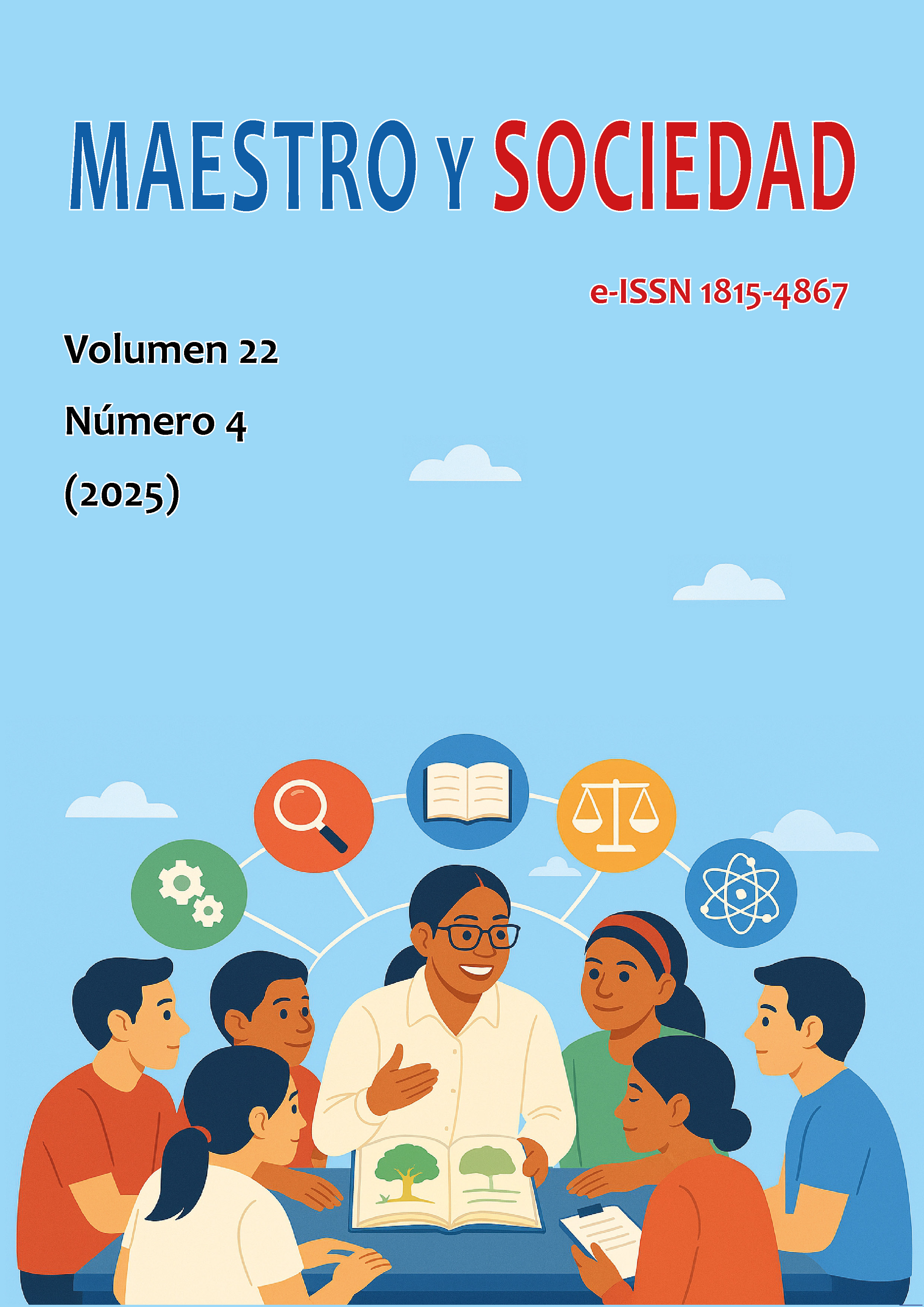
Downloads
Published
How to Cite
Issue
Section
License
Copyright (c) 2025 Shirley Yuliana Flores Tomalá, Rolando Patricio Reyes Chicango, Erika Michelle Chiriguayo Rodríguez, William Baldomero Sulca Bravo

This work is licensed under a Creative Commons Attribution-NonCommercial-NoDerivatives 4.0 International License.
This journal provides immediate open access to its content, based on the principle that offering the public free access to research helps a greater global exchange of knowledge. Each author is responsible for the content of each of their articles.





















 Universidad de Oriente